
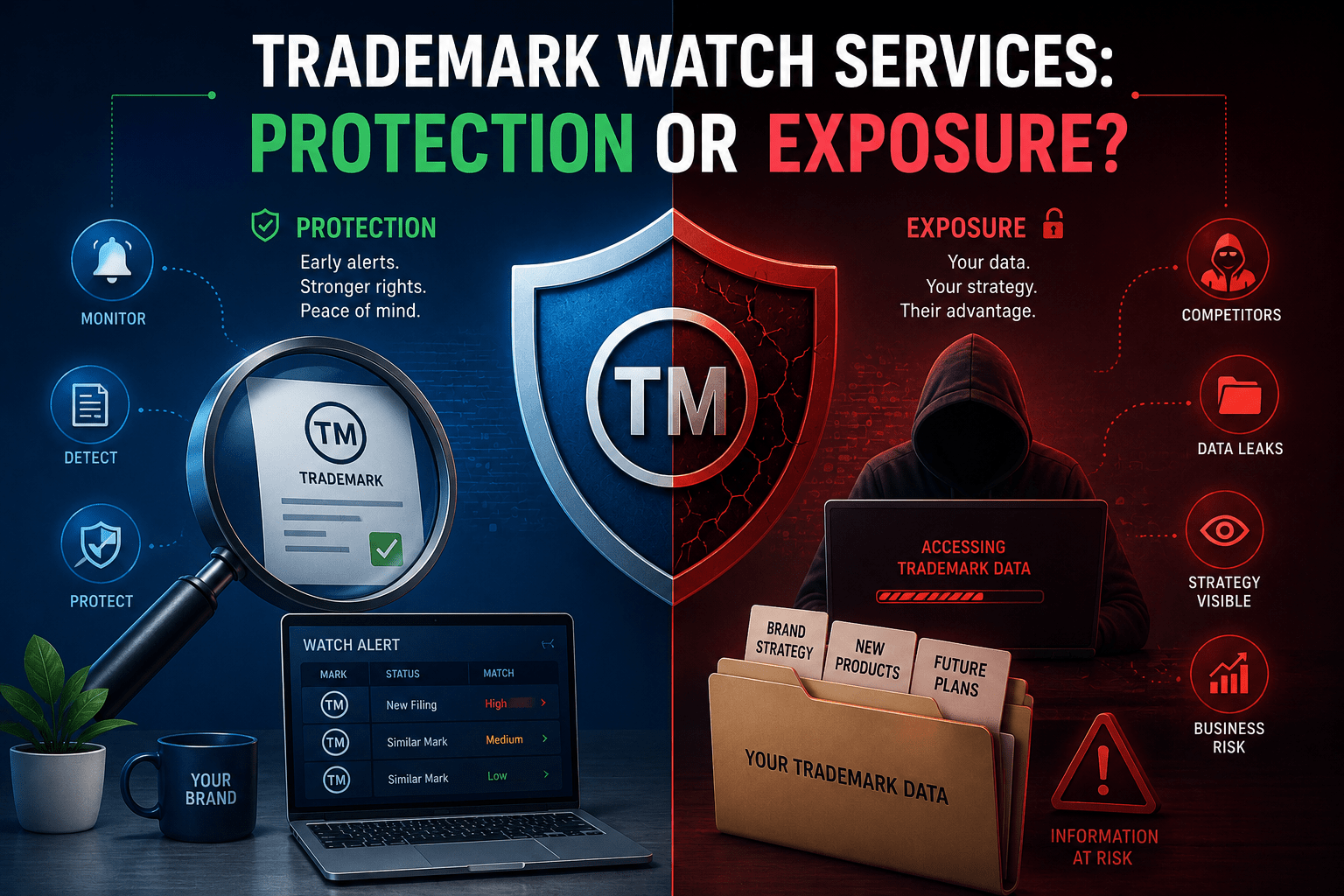
Trademark Watch Services: Protection or Exposure?
In an increasingly digital and brand-driven economy, trademarks have become critical assets for businesses of all sizes. Protecting these assets requires vigilance, and for decades, trademark watch services have played a central role in monitoring potential infringements. These services scan databases, registries, and publications to alert businesses when similar or identical marks are filed. On the surface, this appears to be a straightforward protective mechanism. However, beneath this convenience lies a less discussed reality: traditional trademark watch services may expose more than just your data—they may inadvertently reveal your strategy, priorities, and vulnerabilities.
 At the heart of the issue is the nature of how these services operate. Traditional watch services rely on centralized systems that collect, process, and analyze large volumes of trademark-related information. To provide accurate monitoring, businesses are required to share their attorney codes or in some cases – detailed information about their trademarks, including current registrations, pending applications, expansion plans, and sometimes even future branding intentions. While this data sharing is necessary for the service to function effectively, it also creates a repository of sensitive business intelligence.
 One of the primary concerns is data aggregation. When multiple companies entrust their trademark portfolios to a single service provider, that provider gains access to a wide spectrum of competitive information. Over time, patterns begin to emerge—industries being targeted, regions of expansion, and even the timing of new product launches. If not managed with strict confidentiality protocols, this aggregated data can become a goldmine for unintended exposure. Even without malicious intent, the mere existence of such concentrated information increases the risk of leaks, breaches, or misuse.
 Another layer of vulnerability arises from third-party dependencies. Many traditional trademark watch services rely on external vendors, subcontractors, or automated tools to perform searches and analyses. Each additional layer introduces another point of potential exposure. Data may be transferred across systems, stored in multiple locations, or accessed by various personnel, often across different jurisdictions. This fragmented handling of information can weaken security controls and make it difficult to track where and how sensitive data is being used.
Moreover, traditional systems are not always built with modern cybersecurity threats in mind. Some legacy platforms still operate on outdated infrastructure, lacking advanced encryption, real-time threat detection, or robust access controls. In such environments, even basic vulnerabilities can be exploited by cybercriminals. A breach in a trademark watch service does not just compromise names and filings—it can expose business strategies, upcoming brand launches, and market entry plans. For competitors, this information can provide a significant advantage.
While technical vulnerabilities are important, risks associated with human access cannot be overlooked. Employees within service providers often have visibility into client portfolios. While most organizations enforce confidentiality agreements, human error remains a persistent risk. An accidental email, misconfigured database access, or even internal misuse can lead to unintended disclosures. In industries where timing and secrecy are crucial, even a small leak can have outsized consequences.
Additionally, traditional watch services may inadvertently signal your intentions to the market. When monitoring is conducted through publicly visible mechanisms—such as repeated oppositions, alerts, or filings—

it can reveal which marks a company considers important. Competitors may infer areas of focus, identify gaps, or even pre-emptively file similar trademarks in unmonitored regions. In this way, the act of protecting a trademark can paradoxically expose the broader strategy behind it.
There is also a growing concern around data ownership and control. Many businesses assume that the information they provide to watch services remains strictly theirs. However, terms of service may allow providers to use anonymized or aggregated data for analytics, benchmarking, or product improvement. While this may seem harmless, it raises questions about how much insight others might gain indirectly. Even anonymized data, when combined with other sources, can sometimes be reverse-engineered to reveal sensitive patterns.
The rise of artificial intelligence and machine learning further complicates the landscape. Traditional watch services are increasingly incorporating these technologies to enhance detection capabilities. While beneficial, these systems require large datasets to function effectively. This means more data is being collected, stored, and processed than ever before. Without clear transparency on how these models are trained and how data is handled, businesses may unknowingly contribute to systems that extend beyond their control.
While these challenges are real, businesses can take proactive measures to minimize their exposure and strengthen the security of their trademark monitoring processes.
- Due diligence is essential – Not all trademark watch services are created equal. Companies should carefully evaluate providers based on their data security practices, compliance standards, and transparency policies. Questions around encryption, data storage, access controls, and incident response should be non-negotiable.
- Limit data sharing to what is strictly necessary – While it may be tempting to provide comprehensive information for better monitoring, businesses should critically assess what is required and avoid oversharing sensitive strategic details.
- Consider adopting modern alternatives – Newer, technology-driven solutions are emerging that prioritize privacy, decentralization, and user control. These platforms often leverage secure architectures and allow businesses to retain greater ownership over their data while still benefiting from effective monitoring.
- Implement internal safeguards – Even when using external services, companies should maintain their own tracking mechanisms, regularly audit access logs, and ensure that internal teams are aware of potential risks associated with data sharing.
- Legal clarity is crucial – Contracts with service providers should clearly define data ownership, usage rights, and liability in case of breaches. Strong legal frameworks can act as a safeguard against misuse and provide recourse if issues arise.
In conclusion, while traditional trademark watch services play an important role in protecting intellectual property, they are not without risks. In a world where data is as valuable as the assets it represents, businesses must look beyond surface-level benefits and consider the broader implications of sharing sensitive information. Protecting a trademark should not come at the cost of exposing the very strategy that gives it value. By approaching these services with awareness and caution, companies can strike a balance between vigilance and security—ensuring that their protection mechanisms do not become points of vulnerability.